
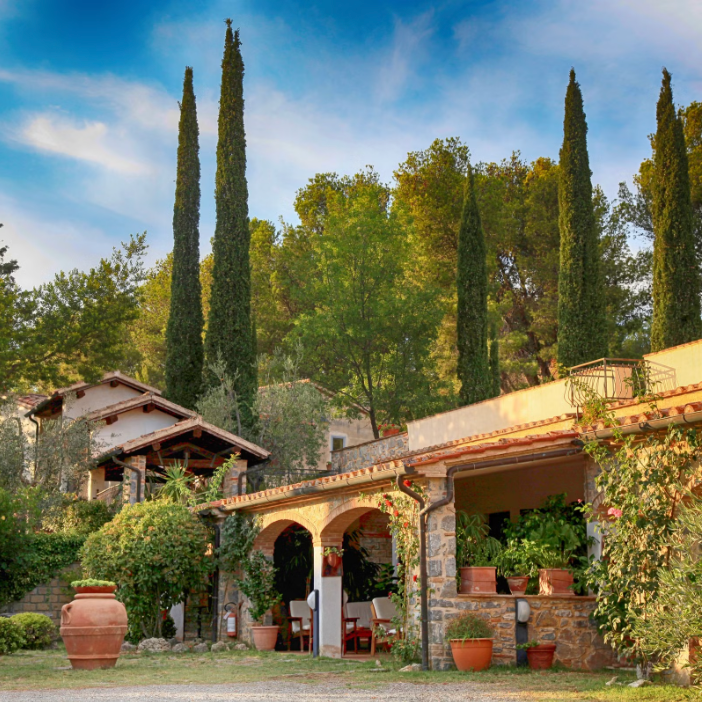
Behind the Walls: A Journey Through Tuscany's Most Extraordinary Gardens
October 2–11, 2027 | A Discover Garden Tours Experience
There are journeys that take you somewhere new, and then there are journeys that take you somewhere you didn't know existed. The Tuscan Gardens Tour is the second kind.
Over ten days in October 2027, a small group of garden lovers, curious travellers, and lovers of the beautiful will trace a path through some of the most remarkable private and historic gardens in all of Europe — many of them closed to the general public, accessible only through the connections and careful curation that make this tour something truly apart.
This is not a sightseeing trip dressed up with flowers. It is a slow, immersive journey into the soul of Tuscany — into its landscapes, its history, its flavours, and the extraordinary human desire to transform a patch of earth into something that endures for centuries.
Florence: Where Every Corner Holds a Secret
The tour begins where the Italian Renaissance began — in Florence, a city so layered with beauty that it takes days simply to begin to feel at home in it.
After arriving at the Hotel Rosso 23, a handsome four-star property right on the Piazza Santa Maria Novella, guests are welcomed at a dinner at the nearby Ristorante Storico Sabatini — a gentle introduction to the convivial spirit that carries through the entire journey.
The first full day in Florence is deliberately unhurried. Sleep in. Linger over a cappuccino in the Piazza della Repubblica or the Piazza della Signoria. Wander the stalls of the Mercato Centrale, where the counters overflow with aged Parmigiano, fragrant truffles, hand-pressed olive oils, and cured meats. For art lovers, the Accademia and the Uffizi both beckon — one to stand, speechless, before Michelangelo's David; the other to spend the better part of a day in the company of Botticelli, Leonardo, and Raphael. Those who prefer to wander might cross the Arno into the Oltrarno district, where medieval workshops still craft leather goods, ceramics, silk, and perfume in the old manner.
Day Three brings the guided experience into focus. An expert leads a four-hour walking tour through Florence's historic heart before revealing one of the city's most astonishing secrets: the Torrigiani Gardens, tucked in the Santo Spirito district. The largest privately-owned garden in Europe — and it sits right in the middle of Florence. The visit is intimate and exclusive: guests are welcomed and guided personally by one of the owners, an experience that no guidebook can replicate.
Day Four belongs to the two great public gardens of Florence. The Boboli Gardens — one of the finest expressions of Italian landscape design ever conceived — winds through amphitheatres, citrus groves, a magical island garden, and long woodland avenues, recently restored to their full splendour. In the afternoon, the Bardini Garden offers something altogether more personal: ten woodland acres framed by medieval walls, with a baroque staircase worthy of a fairy tale, an Anglo-Chinese woodland, a wisteria pergola, and views over Florence that stop you mid-breath. As the afternoon fades, the group settles into its countryside base, the 4-Star Superior Villa Olmi — an 18th-century villa perched on the hills above the city, whose terracotta floors, wood-beam ceilings, and ancient wine cellar set the tone for the days ahead.
Into the Hills: Olive Oil, Film Sets, and a Garden Praised by Edith Wharton
Day Five ventures out to Fiesole to visit the Villa di Maiano, built in 1400 by the Pazzi family and later acquired by the eccentric English aristocrat Sir Temple Leader, who restored it meticulously while preserving its original 17th and 18th century furnishings. Film buffs will recognise it: James Ivory chose it as the Italian location for A Room with a View.
The estate also encompasses Fattoria di Maiano, a completely organic agricultural property of nearly 300 hectares with 20,000 olive trees harvested entirely by hand. The group enjoys an olive oil tasting and lunch here — a grounding, delicious encounter with the Tuscan land at its most productive.
The afternoon takes the group to Villa Gamberaia in Settignano, a garden that Edith Wharton herself praised as "probably the most perfect example of the art of producing a great effect on a small scale." Its water parterre, commissioned in the 1920s, and its centuries of layered history make it one of the most quietly astonishing places in all of Tuscany.
Siena, Montalcino, and the Farmhouse in the Valley
Day Six turns south. The route winds through the Chianti hills before arriving at Villa Vico Bello in the Sienese countryside, where a light lunch is paired with another olive oil tasting. A short walking tour of medieval Siena follows — a city whose art and architecture remain one of Italy's great cultural achievements — before the group continues to Montalcino for a wine tasting at Le Potazzine, a boutique estate whose name ("little hoopoes") is a gentle tribute to the birds that inhabit its grounds.
By evening, the group arrives at Fattoria del Colle, home for the next three nights. Owned by celebrated winemaker Donatella Cinelli Colombini, this working farmhouse estate in the Orcia Valley is far more than a place to sleep. It is an experience in itself: vineyards, olive groves, a Tuscan kitchen restaurant, naturalistic trekking trails, a vinotherapy wellness area, and the kind of unhurried, genuine hospitality that reminds you what travel is for.
Villa La Foce, Castello di Celsa, and the First Hanging Garden of the Renaissance
Day Seven is a full day of garden splendour in the Val d'Orcia. The morning brings Villa La Foce — the beloved home of Iris Origo, the acclaimed author of The Merchant of Prato — whose gardens were commissioned in the 1920s by the Marchesa Origo and designed by Cecil Pinsent on land so inhospitable it had been deemed unfit for farming. Heavy clay, scarce water, and a difficult hillside were transformed, through extraordinary perseverance, into one of the crown jewels of Italian garden design.
The afternoon moves on to the magnificent Castello di Celsa, whose garden origins stretch back to 1500, with portions attributed to the Sienese architect Baldassare Peruzzi. Successive eras have each added their own voice: a Baroque semicircular pool, a fishing pond at the edge of an ancient holm oak wood, formal parterres, cypress hedges, and a grove of conifers that lends the whole an English Landscape quality. Layer upon layer of history, set against a panorama of the Sienese countryside.
Day Eight brings Pienza — one of the most beguiling hill towns in all of Tuscany, and a UNESCO World Heritage Site. At its heart stands Palazzo Piccolomini, commissioned in 1459 by Pope Pius II and widely regarded as the first true example of Renaissance architecture. The palazzo remained a family home until 1962, and every original furnishing was left behind. To walk through its rooms is to feel five centuries of quiet life. At the rear, the celebrated Piccolomini Gardens — the first hanging garden of the Renaissance — perch above the valley in a perfectly proportioned square, enclosed by walls, anchored by a central well. Among Italian gardens, it is virtually without equal.
A visit to a nearby organic cheese farm follows, with a lunch of fresh Pecorino and locally cured meats taken at the source. The afternoon is free in Montepulciano, where medieval lanes, artisan shops, and the celebrated Vino Nobile await.
A Last Evening in Florence
Day Nine brings the group back to Florence for a final afternoon at leisure in the city before gathering for a Farewell Dinner — a celebratory evening to raise a glass, share the moments that caught you off guard, and toast the friendships made along the way.
On Day Ten, after a final breakfast, private transfers return everyone to Florence airport. Hearts full. Bags perhaps holding a bottle of Brunello or two.
Why This Tour is Different
What sets the Tuscan Gardens Tour apart is not simply the places it visits, though those are extraordinary. It is the quality of access — the privately-owned gardens rarely open to the public, the personal welcome from owners, the expert botanical guides who give each visit genuine depth. It is the accommodation — from a four-star hotel on one of Florence's great piazzas to a working farmhouse in the Val d'Orcia where the landscape is your daily companion. And it is the pace — the unhurried mornings, the long lunches, the evenings that feel earned.
Tuscany is endlessly visited. But seen like this — through its hidden walls, its private gates, and the guidance of people who truly know it — it reveals something most visitors never find.
The Tuscan Gardens Tour departs October 2, 2027. Places are limited. For more information, contact Discover Garden Tours.